
Etsy vs Shopify (2026): What the Fee Data, SEC Filings, and Platform Trends Actually Show
If you’ve been weighing Etsy vs Shopify for your US-based business, you’ve likely read a dozen articles that end with “it depends.” That’s not especially useful when you’re trying to make a real decision.
This guide takes a different approach. Instead of recycling the same feature comparison, it goes directly to primary sources — Etsy’s own Help Center documentation, Shopify’s verified pricing, and Etsy’s publicly filed investor reports and lets that data drive the analysis. What those sources reveal about where each platform is heading in 2026 makes the decision significantly clearer than most comparison articles suggest.
The One Data Point That Reframes the Entire Etsy vs Shopify Decision
Before looking at individual fees, there’s a headline metric worth understanding first.
According to Etsy Inc.’s Q1 2026 SEC earnings filing, the platform’s consolidated revenue take rate — the percentage of total seller gross merchandise sales that Etsy captures reached 25.7% in Q1 2026, up 180 basis points year-over-year.
That’s not a fee on any single invoice. It’s the aggregate of every transaction fee, processing charge, Offsite Ad deduction, and on-site advertising cut across the entire platform. The quarterly trend is consistent: 23.3% in Q1 2025, 24.0% in Q2 2025, 24.5% in Q4 2025, and 25.7% in Q1 2026. One direction, every quarter.
Simultaneously, Etsy’s Q3 2025 SEC filing reports active buyers falling to 86.6 million — down 5.0% year-over-year — while seller count grew. More sellers competing for fewer buyers, with Etsy taking a larger share of every sale.
That’s the structural backdrop no competitor article is currently using to frame this comparison.
What Each Platform Actually Is
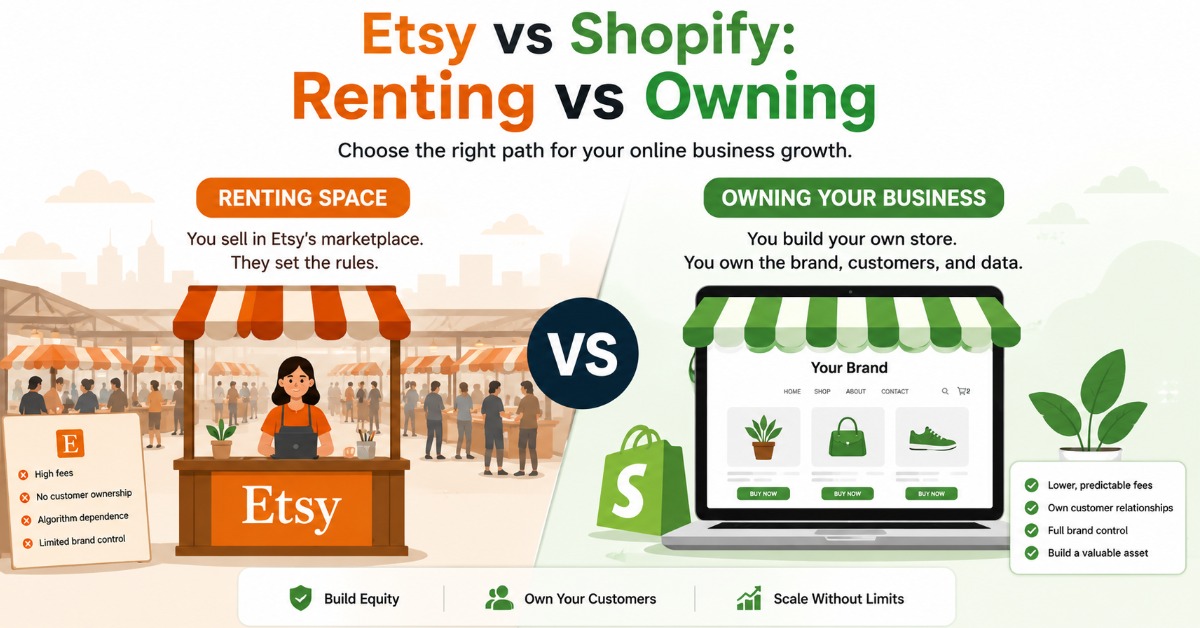
Etsy is an online marketplace. You list products inside someone else’s store — Etsy sets the rules, owns the search algorithm, controls the buyer relationship, and collects an expanding cut of your revenue. For handmade sellers and creators starting out, the built-in traffic is a genuine advantage. For established businesses, the compounding fee structure and lack of ownership become real constraints.
Shopify is an independent ecommerce platform. You build a standalone online store on your own domain, own your customer data, and pay Shopify a flat subscription plus card processing fees. Per Charle Agency’s verified 2026 Shopify pricing guide, Shopify currently offers five US plans from $5/month through enterprise-level Shopify Plus — with no percentage cut of your sales volume.
These aren’t equivalent options. They serve different stages and different business models, and the data makes a fairly clear case about which one builds a more durable long-term business.
Etsy vs Shopify Fees: The Full Breakdown From Official Sources
Etsy Fees in 2026 — Sourced From Etsy’s Own Help Center
The following fee structure is taken directly from Etsy’s official “Fees and Taxes for Selling on Etsy” Help Center page — the authoritative source for current US seller fees:
| Fee | Official Rate |
|---|---|
| Listing fee | $0.20 per listing, active 4 months |
| Transaction fee | 6.5% of total order (item + shipping + gift wrap) |
| Payment processing (US) | 3% + $0.25 per transaction via Etsy Payments |
| Offsite Ads — under $10K/year | 15% on ad-attributed sales — optional |
| Offsite Ads — $10K+/year | 12% on ad-attributed sales — mandatory, permanent |
| Currency conversion | 2.5% if listing and payment currencies differ |
One detail worth flagging from Etsy’s official payment processing fee documentation: the 3% + $0.25 processing fee applies to the total sale price including shipping charges and applicable sales tax not just the item price. If you charge $8 for shipping on a $42 item, the transaction fee and processing fee both apply to the full $50.
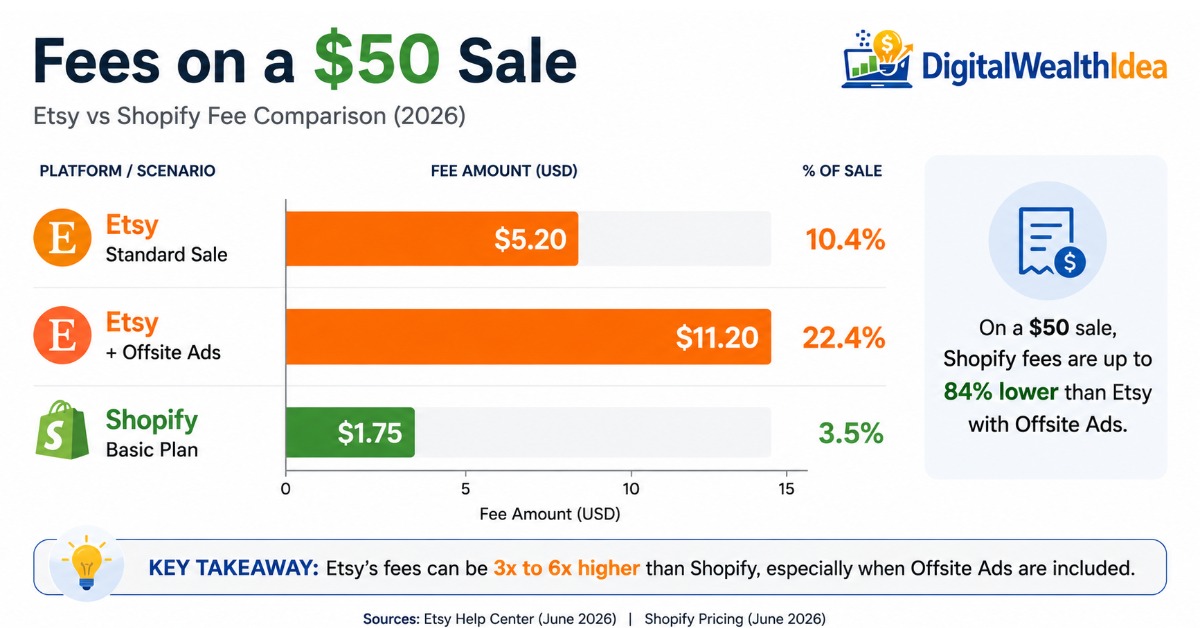
What a $50 sale actually costs — two scenarios:
Scenario A — Standard sale, no Offsite Ads:
| Deduction | Amount |
|---|---|
| Transaction fee (6.5%) | $3.25 |
| Payment processing (3% + $0.25) | $1.75 |
| Listing fee (prorated) | $0.20 |
| Total fees | $5.20 |
| You keep | $44.80 (89.6%) |
Scenario B — Same $50 sale, Offsite Ads attributed (post-$10K threshold):
| Deduction | Amount |
|---|---|
| Transaction fee (6.5%) | $3.25 |
| Payment processing (3% + $0.25) | $1.75 |
| Offsite Ads fee (12%) | $6.00 |
| Listing fee | $0.20 |
| Total fees | $11.20 |
| You keep | $38.80 (77.6%) |
That’s a 22.4% effective fee rate before material costs, labor, or packaging. For sellers with standard handmade product margins, that number frequently tips a profitable order into a loss.
The Offsite Ads Threshold The Detail Most Sellers Learn Too Late
Etsy’s own Help Center confirms that once a shop reaches $10,000 in trailing 365-day sales, the 12% Offsite Ads fee becomes mandatory. What it doesn’t make prominent: per SpySeller’s 2026 policy analysis and ListingForge’s documentation, this status does not revert even if sales subsequently fall below $10,000. Crossing the threshold once is permanent.
$10,000 annually is $833/month — a level many part-time sellers hit within 18 months without realizing the implications. Craftybase’s seller research documents sellers deliberately managing their sales volume to delay crossing this threshold — which is itself a constraint on growth that no Shopify seller faces.
The Fee History Context
Etsy’s transaction fee was raised from 5% to 6.5% in April 2022 a 30% increase. Fortune reported that over 47,000 sellers signed a petition in protest, with thousands temporarily closing their shops. Etsy confirmed the increase in its official seller community announcement. Etsy’s SEC filings consistently cite growing take rate as a platform revenue priority — sellers building long-term plans around today’s fee structure are making an assumption the platform’s own communications don’t support.
Shopify Pricing in 2026 — Verified Official Rates
Per Charle Agency’s verified 2026 Shopify pricing guide and Demandsage’s pricing breakdown:
| Plan | Monthly (Annual billing) | Online Card Rate (Shopify Payments) |
|---|---|---|
| Basic | $29/mo | 2.9% + $0.30 |
| Grow | $79/mo | 2.6% + $0.30 |
| Advanced | $299/mo | 2.4% + $0.30 |
When using Shopify Payments, there is no separate transaction fee — only the card processing rate above. Using a third-party gateway adds 0.5%–2% depending on plan.
What a $50 sale costs on Shopify Basic:
| Deduction | Amount |
|---|---|
| Payment processing (2.9% + $0.30) | $1.75 |
| Transaction fee | $0.00 |
| Listing fee | $0.00 |
| Total fees | $1.75 |
| You keep | $48.25 (96.5%) |
The $29–$39/month plan subscription amortizes across total monthly volume. At $2,000/month, that’s less than 2 cents added per dollar — well below Etsy’s compounding percentage structure at the same volume.
Current trial offer: PageFly’s verified June 2026 guide confirms Shopify currently offers new merchants a 3-day free trial, then $1/month for three months on Basic, Grow, and Advanced plans before standard billing begins.
Where Etsy Still Makes Sense in 2026
The fee data doesn’t mean Etsy has no value. Per Etsy’s Q1 2026 SEC filing, Etsy marketplace GMS reached $2.46 billion in a single quarter — that’s genuine, active transaction volume. Selling on Etsy means immediate access to buyers who are already searching for handmade, vintage, and personalized products. A well-optimized listing can generate sales within days of going live, without any advertising spend.
The data supports Etsy when:
- You’re selling handmade, vintage, or personalized goods and need to validate demand without upfront infrastructure investment
- Monthly revenue is under $800 and the Shopify subscription cost isn’t yet justified by volume
- You’re in the early phase of testing which products actually sell before committing to a full brand
- Building initial reviews matters more right now than owning long-term customer relationships
Etsy functions best as a discovery and validation channel. Its value relative to cost declines meaningfully once monthly volume crosses $1,000–$1,500 and the Offsite Ads fee becomes a material margin issue.
Platform Dependency: The Risk Most Comparisons Underweight
On Etsy, the seller’s business exists at Etsy’s discretion. Etsy’s own community forums document instances of shops being placed in forced vacation mode or suspended — often with limited explanation and no immediate recourse. Customer email addresses, purchase history, and buyer relationships belong to Etsy. A suspension means immediate revenue loss with no ability to contact your own customers.
On Shopify, the business asset belongs to the merchant entirely. Customer lists, domain equity, SEO authority built through a Shopify blog — all of it is the merchant’s property. Lovable’s 2026 platform analysis cites case studies like The Woobles, which scaled from a small craft operation to large-scale production in under four years, specifically citing Shopify’s infrastructure and merchant ownership model as primary factors.
SEO and Discoverability: The Gap That’s Widening
On Etsy, SEO means optimizing for Etsy’s internal algorithm — titles, tags, and attributes. Listings can surface in Google through Etsy’s strong domain authority, but you control none of the technical infrastructure.
On Shopify, sellers have full SEO control: custom meta titles, clean URL structure, schema markup, XML sitemaps, and a built-in blog for content marketing. In 2026 specifically, Shopify stores with structured content are increasingly appearing in Google AI Overviews — something Etsy listings have no meaningful path to at a brand level. Every SEO investment on Shopify compounds as an asset the seller owns permanently.
When to Switch From Etsy to Shopify — The Two-Phase Strategy
Analysis of seller community discussions and documented migration patterns points consistently to the same approach among sellers who build durable independent businesses:
Phase 1 — Etsy as validation (Months 0–6): Use Etsy’s built-in traffic to test products at low cost ($0.20/listing, no monthly fee). Confirm demand, build reviews, and understand what converts before investing in brand infrastructure. At sub-$800/month, Etsy’s traffic advantage outweighs its fee disadvantages.
Phase 2 — Shopify as the primary platform (Month 6+): Once product-market fit is confirmed, launch a Shopify store and begin building customer data, email lists, and SEO equity. Keep Etsy running for new customer discovery. As Charle Agency documents: “Etsy becomes the prospecting channel. Shopify becomes the home.” Repeat purchase revenue and brand equity live on Shopify — the platform you actually own.
Etsy vs Shopify: Summary by Seller Situation
| Your Situation | Recommended Platform |
|---|---|
| Unvalidated product, first seller | Start on Etsy |
| Under $800/month consistently | Etsy |
| $1,000–$3,000/month | Add Shopify, run both |
| Approaching $10K/year in Etsy sales | Prioritize Shopify now |
| Over $10K/year, Offsite Ads mandatory | Shift primary focus to Shopify |
| Selling non-handmade/non-vintage | Shopify from day one |
| Building a brand for long-term value | Shopify as primary platform |
| Platform dependency is a concern | Shopify — ownership case is clear |
Frequently Asked Questions
Is Etsy or Shopify better for beginners? For beginners selling handmade or vintage goods, Etsy has a clear early advantage — no monthly fee, built-in buyer traffic, and the ability to have a listing live within hours. Shopify requires traffic generation from day one and carries a $29–$39/month subscription. The data supports starting on Etsy and adding Shopify once monthly revenue consistently clears $800–$1,000.
What are the fees for Etsy vs Shopify on a $50 sale? Per Etsy’s official Help Center, a standard $50 Etsy sale costs approximately $5.20 in fees (10.4%). With Offsite Ads attribution post-$10K threshold, that rises to $11.20 (22.4%). On Shopify Basic with Shopify Payments, the same $50 sale costs $1.75 in processing fees (3.5%) plus the prorated plan subscription.
Can you use Etsy and Shopify at the same time? Yes. Most sellers who successfully transition run both simultaneously for at least 90 days. Tools like Shuttle and Etsy Marketplace Connect allow inventory syncing across both platforms from a single dashboard.
What is Etsy’s take rate in 2026? Per Etsy’s Q1 2026 SEC filing, Etsy’s marketplace take rate was 25.7% in Q1 2026 — the percentage of total gross merchandise sales the platform captures as revenue — up from 23.3% in Q1 2025.
Does Shopify have a free trial in 2026? Per PageFly’s verified June 2026 guide, Shopify currently offers a 3-day free trial followed by $1/month for three months on Basic, Grow, and Advanced plans. Standard pricing applies from month four.
At what revenue point does Shopify become cheaper than Etsy? Based on current fee structures, the crossover falls around $800–$1,200/month for most US sellers. At that volume, Shopify Basic’s total monthly cost (plan + processing) is roughly equivalent to Etsy’s transaction and processing fees. The gap in Shopify’s favor widens materially at $2,000+/month.
Conclusion: What the Sources Actually Recommend
The Etsy vs Shopify decision in 2026 isn’t really about which platform has better features. It’s about what you’re trying to build and what the data shows about where each platform is heading.
Etsy’s own investor filings show a take rate that has grown every quarter for two years, a declining buyer base, and a growing seller count — more competition, fewer buyers, higher fees. Etsy’s official Help Center documents a fee structure that can reach 22%+ on individual sales once Offsite Ads attribution kicks in, with no opt-out available after the $10,000 threshold.
Shopify’s flat subscription model, verified at $29/month on annual billing, means your fee per sale goes down as volume goes up. You own the customer, the domain, and the SEO equity. The $1/month trial removes essentially all risk from testing it alongside an existing Etsy shop.
For most US sellers in 2026, the research-supported path is clear: use Etsy to validate, build on Shopify to scale.
