

Shopify Basic vs Grow vs Advanced: Which Plan Should You Choose in 2026?
Choosing between Shopify Basic, Grow, and Advanced isn’t simply about picking the plan with the most features.
The better question is: Which Shopify plan fits your store’s current sales, team size, shipping needs, and growth stage?
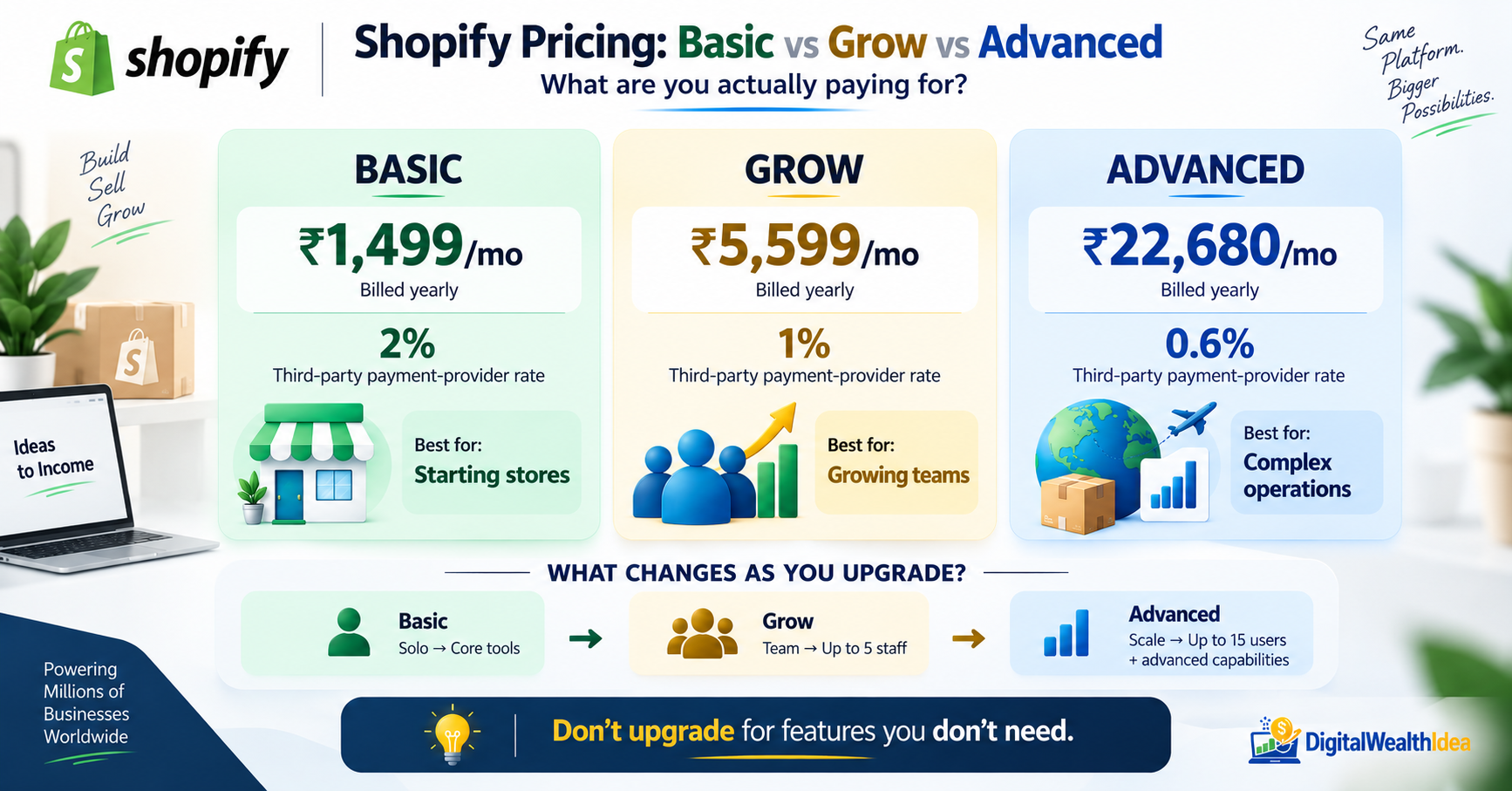
Shopify’s India pricing currently lists Basic at ₹1,499/month when billed yearly, Grow at ₹5,599/month, and Advanced at ₹22,680/month. The listed third-party payment-provider rates are 2%, 1%, and 0.6%, respectively.
That makes the difference between plans significant. So, before paying for a higher tier, it’s worth understanding what you actually get.
Shopify Basic vs Grow vs Advanced: What’s the Difference?
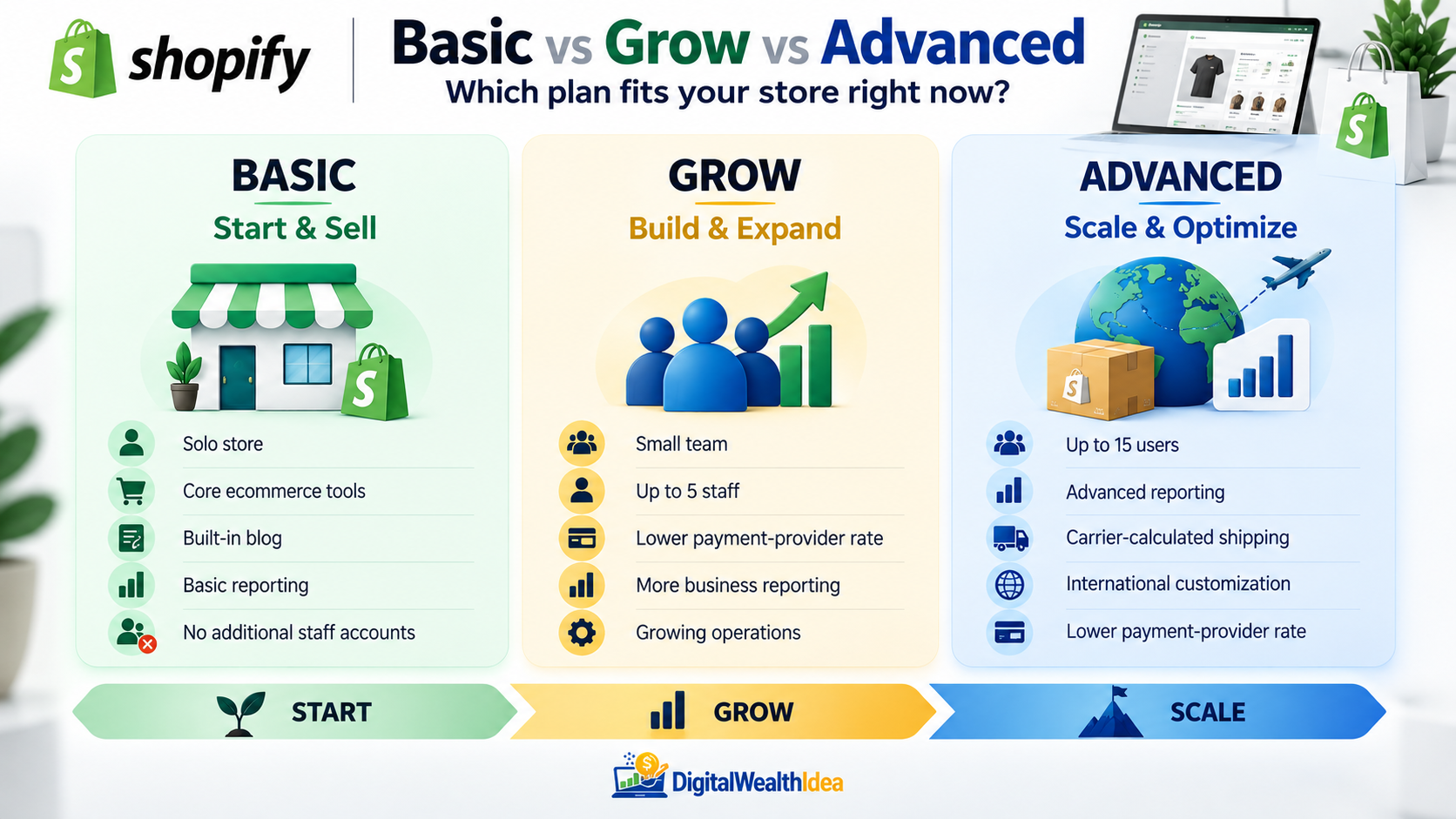
The easiest way to understand the plans is by business stage.
Shopify Basic is built around the core tools needed to start and run an online store.
Shopify Grow adds more capacity for businesses with a small team and increasing sales activity.
Shopify Advanced is aimed at businesses with more complex requirements, including advanced reporting, shipping, staff access, and international customization.
In simple terms:
Basic → Start
Grow → Grow a team and sales operation
Advanced → Manage greater complexity
A higher-priced plan isn’t automatically more suitable. Your actual requirements matter more.
How Much Does Shopify Basic, Grow, and Advanced Cost?
Here is the current Shopify India pricing:
| Plan | Yearly Billing | Monthly Billing | Third-Party Provider Rate |
| Basic | ₹1,499/mo | ₹1,994/mo | 2% |
| Grow | ₹5,599/mo | ₹7,447/mo | 1% |
| Advanced | ₹22,680/mo | ₹30,164/mo | 0.6% |
You can check the latest figures on Shopify India pricing.
The jump from Basic to Grow is ₹4,100/month on yearly billing, while Grow to Advanced is another ₹17,081/month.
That is why choosing based purely on the feature list can be misleading.
What Do You Get With Shopify Basic?
Shopify Basic provides the core infrastructure needed to operate an online store.
It includes an online storefront, product and order management, customer management, checkout, inventory tools, SSL, reports, international commerce tools, and a built-in blog.
Shopify also provides a detailed Shopify Basic plan features guide.
Is Shopify Basic Enough for a New Store?
For many new stores, yes.
Basic can work well if you’re:
- Running the store yourself
- Selling a relatively small catalog
- Starting with one main market
- Using standard shipping
- Not managing a large team
You don’t need Advanced just because you eventually want to grow.
Starting with Basic can let you validate the store before taking on a much higher subscription cost.
What Does Shopify Grow Add to Basic?
Grow becomes more useful when your store moves beyond a solo operation.
One of the clearest differences is staff access.
Currently:
- Basic: no additional staff accounts
- Grow: up to 5 staff accounts
- Advanced: up to 15 user accounts
Grow also has a lower listed third-party payment-provider rate than Basic.
When Should You Consider Shopify Grow?
Grow may make more sense when:
- Several people need Shopify access
- Sales are becoming consistent
- Payment fees are becoming more noticeable
- Your operations are becoming more complex
- You need greater team capacity
For a one-person store, these features may not justify the additional subscription.
How Do Shopify Transaction Fees Affect Your Choice?
Transaction fees can become important as sales increase.
For India, Shopify currently lists third-party payment-provider rates of:
- Basic: 2%
- Grow: 1%
- Advanced: 0.6%
These shouldn’t be confused with the payment processor’s own processing fees.
For example, a 1 percentage-point difference represents ₹1,000 for every ₹1 lakh of applicable transaction volume.
But that doesn’t automatically mean upgrading is cheaper.
You need to compare the fee savings against the additional subscription cost.
For a deeper explanation, see our Shopify transaction fees explained.
Does Shopify Advanced Have Lower Payment Fees?
Yes.
Advanced currently has the lowest listed third-party payment-provider rate among these three plans in India: 0.6%.
However, Advanced also has a much higher subscription price.
So payment-fee savings alone shouldn’t automatically determine your decision.
The calculation becomes more meaningful when you have enough applicable sales volume to make the lower rate financially significant.
What Makes Shopify Advanced Different From Grow?
Advanced is designed for more complex ecommerce operations.
Its additional capabilities include:
- Up to 15 user accounts
- Carrier-calculated shipping
- More comprehensive reporting
- Custom reports
- Predicted values for certain reports
- Lower listed payment-provider rates
- Additional international customization
Shopify’s official documentation explains these capabilities in its Shopify Advanced plan features.
Does Advanced Offer Better Shipping Options?
Yes, particularly for carrier-calculated shipping.
This can be useful when shipping rates need to account for factors such as destination, package weight, dimensions, carrier, and delivery service.
Basic doesn’t support activating third-party carrier-calculated shipping, while Advanced includes it.
Does Shopify Advanced Give You Better Reporting?
Yes.
Advanced provides Shopify’s more comprehensive reporting capabilities, including custom reports and predicted values for certain reports.
This can become more useful as the store generates more sales and operational data.
A small store may not need these capabilities.
A larger operation may use them much more frequently.
Can You Sell Internationally With Shopify Basic?
Yes.
International selling isn’t limited to Advanced.
Shopify’s plans support international commerce and Markets functionality, although specific customization capabilities vary by plan.
This means you don’t necessarily need Advanced just because you want customers from different countries.
What International Features Require Advanced?
The important distinction is between selling internationally and customizing the experience for individual markets.
Advanced supports additional market-specific customization, including online-store theme customization and checkout/customer-account customization.
So a business selling internationally can potentially start with Basic, while a business needing highly customized regional experiences may need Advanced.
Which Shopify Plan Is Better for a Blog and Online Store?
If you want to combine content marketing with ecommerce, Basic already includes blogging functionality.
That means you can build a simple funnel:
Blog content → Search traffic → Product education → Product page → Checkout
You don’t need Advanced simply because blogging is part of your strategy.
The bigger considerations are your team, sales volume, shipping requirements, reporting needs, and international operations.

When Does Shopify Grow Make More Sense Than Basic?
Grow becomes more relevant when your business is becoming a small team rather than a one-person store.
Consider Grow when you need:
- Multiple staff accounts
- More operational capacity
- Lower listed third-party payment-provider rates
- More advanced business reporting
- A plan that better matches increasing sales activity
If you’re still testing your product and operating alone, Basic may provide everything you currently need.
When Does Shopify Advanced Make More Sense Than Grow?
Advanced becomes more relevant when your store has specific operational requirements.
Consider it when you need:
- More than five staff accounts
- Carrier-calculated shipping
- More comprehensive reporting
- Custom reports
- Market-specific storefront customization
- Market-specific checkout customization
- Lower listed third-party payment-provider rates
The key is to upgrade because you need the capabilities, not simply because Advanced is the highest plan.
What Is the Break-Even Point Between Shopify Plans?
There is no universal break-even sales number.
Your calculation should consider:
Additional subscription cost
versus
Potential payment-fee savings + value of additional features
You should also account for apps, domains, themes, shipping, advertising, payment processing, and other operating costs.
For a broader look at Shopify’s costs at different business stages, see our Shopify pricing and real costs by revenue level.
Shopify Basic vs Grow vs Advanced: Which Plan Fits Your Business?
| Your Situation | Plan to Consider |
| Starting a new store | Basic |
| Solo entrepreneur | Basic |
| Small catalog | Basic |
| Growing team | Grow |
| Up to 5 staff accounts | Grow |
| Increasing sales activity | Grow |
| More than 5 staff accounts | Advanced |
| Carrier-calculated shipping | Advanced |
| Advanced reporting | Advanced |
| Market-specific customization | Advanced |
| More complex ecommerce operation | Advanced |
Frequently Asked Questions
Is Shopify Basic good enough for beginners?
Yes. Basic provides the core tools needed to build and operate an online store, including blogging and international commerce tools.
What is the main difference between Basic and Grow?
Grow provides additional staff capacity and a lower listed third-party payment-provider rate.
What is the main difference between Grow and Advanced?
Advanced adds greater staff capacity, carrier-calculated shipping, more comprehensive reporting, and additional international customization.
Does Shopify Basic include a blog?
Yes. Shopify Basic includes built-in blogging functionality.
How many staff accounts does Grow allow?
Grow currently supports up to 5 staff accounts.
How many staff accounts does Advanced allow?
Advanced currently supports up to 15 user accounts.
Does Advanced have lower payment fees?
Yes. Shopify currently lists 0.6% for Advanced in India, compared with 1% for Grow and 2% for Basic.
Can Basic sell internationally?
Yes. Basic supports international commerce, although some advanced market-specific customization requires Advanced.
Final Takeaway
Shopify Basic, Grow, and Advanced are designed for different levels of business complexity.
Basic makes sense for many new and solo stores.
Grow becomes more relevant when your team and sales operation expand.
Advanced is designed for stores that need greater staff capacity, advanced shipping, deeper reporting, and more sophisticated international customization.
Don’t choose the plan with the biggest feature list.
Choose the one that matches your current business requirements, then upgrade when your numbers and operations give you a clear reason to do so.
Starting → Basic
Growing → Grow
Scaling → Advanced


